Childhood Reflexes
Here is a brief description of some other key childhood reflexes and challenges that may occur if these reflexes remain active (Un-Integrated) past the toddler stage. FPR emerges in the first 8 weeks in utero. It is a total body withdrawal away from touch that is normal in utero. The baby in utero reacts to touch by withdrawing inward and freezing. As the baby’s tactile awareness develops, withdrawal upon contact gradually lessons. It is thought that this reflex is the first step in learning to cope with stress. Ideally, FPR merges into the Moro reflex and is dormant before birth. If the FPR is not fully integrated at birth, it can cause life-long challenges related to fear. There is often an underlying anxiety or negativity preventing an individual from moving forward toward meaningful goals. An active FPR often goes hand-in-hand with an un-integrated Moro reflex. Possible Long Term Effects of an Active Fear Paralysis Reflex Shallow, difficult breathing Underlying anxiety or negativity Insecure, low self-esteem Depression/isolation/withdrawal Constant feelings of overwhelm Extreme shyness, fear in groups Excessive fear of embarrassment Fear of separation from a loved one, clinging Sleep & eating disorders Feeling stuck Elective mutism Low tolerance to stress Withdrawal from touch Aggressive or controlling behavior, craves attention Extreme fear of failure, perfectionism Phobias The Moro Reflex, sometimes called the infant startle reflex, is an automatic reaction to a sudden change in sensory stimuli. A sudden change of any kind (bright light, change in body position, temperature, loud noise, intense odor, touch etc.) can trigger the Moro Reflex. The Moro reflex is a combination of movements. The baby’s arms and legs open rapidly upward and away from the body. At the same time there is a quick intake of breath, then a momentary freeze of the arms and legs in the outward position. The arms and legs then return to the normal flexed posture of the infant, and the breath is released, often with a cry.
The Moro reflex is a response to a perceived threat and creates instant arousal of the baby’s survival systems. In essence the baby responds as if reacting to a threat. The Moro reflex trains the baby’s nervous system in developing the “fight or flight” survival response. It is also the baby’s instinctual response to summon a caregiver. 1. Release of stress hormones, adrenaline and cortisol 2. Increase in breathing rate, shallow breathing 3. Increase heart rate and blood pressure Steady, loving and consistent embraces from the baby’s mother/caregiver integrate the Moro reflex when the baby is triggered. When a fearful baby receives protection and comfort, he learns to open up and participate in the world, instead of withdrawing from it.
Ideally, the Moro reflex emerges in the womb at 9-12 weeks gestation and is integrated by 4 months of age. Moro integration is complete when the baby learns a more mature startle reflex (Sometimes called Straus reflex or adult startle reflex). In response to a sudden change or perceived danger, the baby’s shoulders raise and the baby seeks to find the source of the stimulus. If the baby has the means to cope with the event, it will either pay attention to it, or ignore it. This ignoring response is important because it is the basis of a more mature nervous system skill to filter out unwanted stimulus and selectively attend. Possible Long Term Effects of an Active Moro Reflex Sleep disturbances, difficulty settling down to sleep Easily triggered, reacts in anger or emotional outburst Shyness Poor balance and coordination Poor stamina Motion sickness Poor digestion, tendency towards hypoglycemia Weak immune system, asthma, allergies and infections Hypersensitivity to light, movement, sound, touch & smell Vision/reading/writing difficulties Difficulty adapting to change Cycles of hyperactivity and extreme fatigue Easily distracted, difficulty filtering out extraneous stimuli Difficulty catching a ball Difficulty with visual perception Tires easily or is irritable under fluorescent lighting The Tonic Labyrinthine Reflex, has two forms, forward and backward. Forward—As the head bends forward, the whole body, arms, legs and torso curl inward in the characteristic fetal position. Backward—As the head is bent backward, the whole body, arms, legs and torso straighten and extend.
TLR provides the baby with a means of learning about gravity and mastering neck and head control outside the womb. This reflex gives the baby opportunities to practice balance, increase muscle tone and develop the proprioceptive and vestibular senses. Eventually the TLR interacts with other reflexes and bodily processes to help the child develop coordination, posture and correct head alignment from infancy through toddlerhood.
It is critical for the TLR to do its “job” because correct alignment of the head with the rest of the body is necessary for balance, visual tracking, auditory processing and organized muscle tone, all of which are vital to the ability to focus and pay attention. Balance and coordination problems Shrunken posture Fatigues easily Muscle tone usually weak or too tight Difficulty judging distance, depth, space and speed May have a fear of heights “W” leg position when floor sitting Motion sickness Visual, speech, auditory difficulties Tendency to be cross-eyed Stiff jerky movement Toe walking Difficulty walking up and down stairs The ATNR links head and neck movement to one-sided movement. When the infant turns her head to one side, the arm and leg of that side automatically extend. In utero ATNR provides stimulation for developing muscle tone and the vestibular system. It assists in the birth process, providing the means for the baby to “corkscrew” down the birth passage. ATNR also provides training in hand-eye coordination. By six months of age, this reflex should evolve into more complex movement patterns. If the ATNR remains active it is one of the most significant causes of inability to function in school. Possible Long Term Effects of an active ATNR: Dyslexia reading, listening, hand writing and spelling difficulties difficulty with math poor sense of direction confused handedness focus and balance difficulties The STNR helps the baby lift and control the head for far distance focusing. STNR also prepares baby for creeping (crawling) using automatic movements for raising up on all fours. At this stage in development, movement of the head is automatically linked to movement of the arms and legs. If the STNR remains active it is another main cause of inability to function in school. This is because up and down head movements remain linked to arm and leg movements, making school work effortful and difficult. Possible Long Term Effects of an active STNR: squirming or fidgeting; poor posture, slouching headaches from muscle tension difficulty writing and reading difficulty sitting still difficulty copying from blackboard ape-like walking vision disorders trouble staying on task clumsy, messy eater The Spinal Galant Reflex most likely works with the ATNR to aid in the passage down the birth canal. It is also thought to help babies balance and coordinate the body for belly crawling and creeping. It is thought to be connected to bladder function because a high percentage of children who are bedwetting past age 5 have an active Spinal Galant reflex. Possible Long Term Effects of an active Spinal Galant Reflex: Bedwetting fatigue attention difficulties hip rotation to one side poor concentration poor coordination poor posture poor short-term mem fidgeting/hyperactivity difficulty sitting still irritable bowel syndrome (as adult) scoliosis
Oral and Grasping reflexes are linked in infancy. We often see babies kneading their hands while they suckle. When these reflexes remain active, we may see children and adults moving the mouth or tongue while writing or drawing. Active foot reflexes interfere with our ability to walk, think and speak in a flowing rhythm. Possible Long Term Effects of active Oral, Grasping and Foot Reflexes: speech delay or difficulties swallowing problems difficulty in social situations drooling manual dexterity challenges poor pencil grip handwriting difficulties TMJ syndrome loose, easily sprained ankles toe walking flatfooted or walking on sides of feet/hip rotation difficulty expressing written ideas addictions
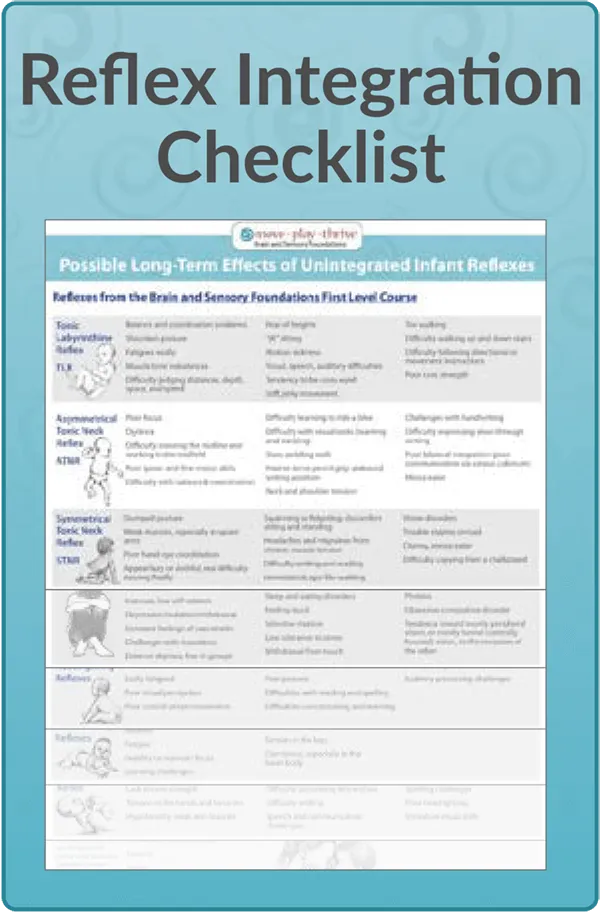
To view a brief PDF information sheet on Reflexes click here-
FPR—Description and Function
Moro Reflex—Description and Function
The following physiological response occurs with the Moro Reflex:
TLR—Description and Function
Possible Long Term Effects of an Active TLR
Difficulty following directional or movement instructions
ATNR—Asymmetrical Tonic Neck Reflex
STNR—Symmetrical Tonic Neck Reflex Spinal Galant Reflex
Oral, Grasping & Foot Reflexes