Your Subtitle text
Importance of Reflexes

Main Concept 


Integrating Reflexes is KEY for the ability to learn easily, get along with others, and meet life’s challenges with greater ease and joy.  Once childhood reflexes are integrated, we move in a flowing, organized pattern and our emotions, thoughts and actions become more organized, effective and positive. Today vast numbers of children and adults are retaining un-integrated reflexes causing widespread difficulties.


Incomplete integration of childhood reflexes can be mild to severe and contribute to anxiety, depression, ADD, ADHD, autism, learning challenges, developmental delay, sensory integration disorders, vision and hearing problems, behavior challenges, extreme shyness, lack of confidence, addiction, inefficient, effortful striving, and constant feelings of overwhelm.  Integrative Movement helps children and adults complete the reflexes and transform challenges into strengths.


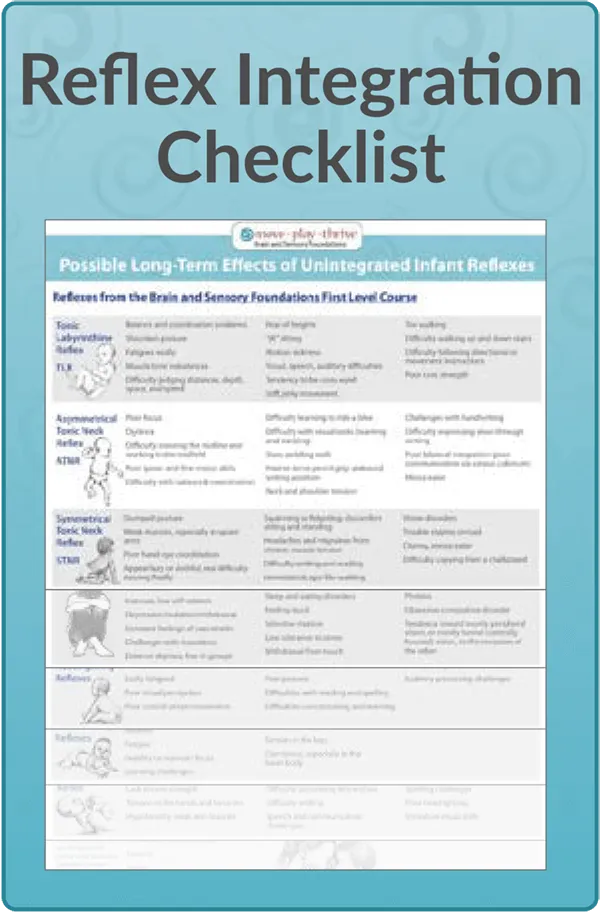
To view a brief PDF information sheet on Reflexes  click here-

What is a Reflex?


A reflex is an automatic, instinctual movement that assists us in our development and survival.  Jerking our hand away from a hot stove is a familiar survival reflex.  Survival reflexes are maintained throughout our lives.  Other reflexes, called “childhood reflexes,” surface in the womb and infancy and are designed to become inactive after the toddler stage.  Ideally, childhood reflexes merge into more sophisticated movements and become integrated.  An integrated childhood reflex is no longer active.  When childhood reflexes remain active (un-integrated), many difficulties emerge.


What Causes Un-integrated Reflexes?


Un-integrated, active childhood reflexes can be caused by:


1. Stress of the mother during pregnancy, breech birth, birth trauma or Cesarean birth.


2. Lack of enough proper movement in early childhood. Plastic carriers, play pens, walkers, jumpers, car seats, TV and computer use, all restrict critical movements required for brain development. 


3. Illness, Trauma, Injury, Chronic Stress. 


4. Environmental Toxins, Complications with Vaccinations.


5. Dietary imbalances or sensitivities.


Even reflexes that are completely integrated can become re-activated later by trauma, injury, toxins and stress.


Why Are Reflexes Important?


From the womb on, the childhood reflex movements literally “grow” the brain.  Repetitive, automatic reflex movements are also essential for the development of balance, mobility, vision, hearing, speaking, learning and relating well with others.  There are five major reasons why the childhood reflexes are critically important.


1. Reflex movements are the first foundation of the nervous system.  Like a block tower, all further development depends on the steadiness of the foundation. 


2. Reflexes originate in the brain stem or survival brain.  When reflexes remain active the survival brain is constantly stimulated.  In this survival mode, there is less ability to access the prefrontal lobes where we think, create and make beneficial decisions.  In other words, we are more likely to react instead of choose.  In addition to heightened reactivity, skills that should eventually become automatic, can only be done with continuous conscious effort.


3. Un-integrated reflexes trigger the “fight or flight” response, creating chronic stress.  Even when there is no logical reason for stress, we can feel stressed because our physiology is constantly reacting as if threatened.  Stress becomes a habit, often below the level of our awareness.


4. When reflexes are active, body parts cannot easily move independently.  A movement of the head causes an  automatic movement in the limbs, hands or feet.  Extra limb movements happen below the surface level and may be too small to notice even for the trained eye.   These linked, reflexive movements create difficulties with coordination, reading, writing, speaking, thinking and bodily functions such as breathing, bladder control and others.  Disorganized, inefficient movements are a reflection of disorganized, inefficient brain activity. A child who fidgets in his chair and cannot focus, is more than likely suffering from active reflexes.  Once reflexes are integrated, head and limb muscle groups can move independently and the ability to sit attentively without fidgeting comes easily. Many adults who can sit motionless, are still experiencing active reflexes, though they’ve learned to suppress them.  Active reflexes often show up as impediments in accomplishing meaningful goals.


5. Active reflexes cause aches and muscle tension, weak muscle tone, fatigue and the need for great amounts of effort to complete tasks.  We unconsciously learn to compensate for and suppress active reflexes, which can cause considerable tension and energy drain. 


Movement and Play For Integration


At any age we can integrate the reflexes and rebuild the foundation of our nervous system through integrative movement programs.  We start by assessing which reflexes are active and in need of integration.  Then we do a series of age-appropriate activities specifically designed for each reflex. Integrative movement is highly effective because it taps into the same system nature uses for reflex integration and brain development.  We add play, because play is fun, healing and transformative. Playful, integrative movement creates quantum shifts and positive change!  Many life challenges are overcome once the childhood reflexes are integrated.


Integrative Movement optimizes effectiveness in all areas of life and is beneficial for all ages and skill levels.  It is effective for reflex integration, whole-brain learning, optimizing skills, reducing stress, eliminating blocks and opening the heart. 


Families especially benefit from the fun, harmony and positive changes that grow from doing movement together.


Web Hosting Companies